
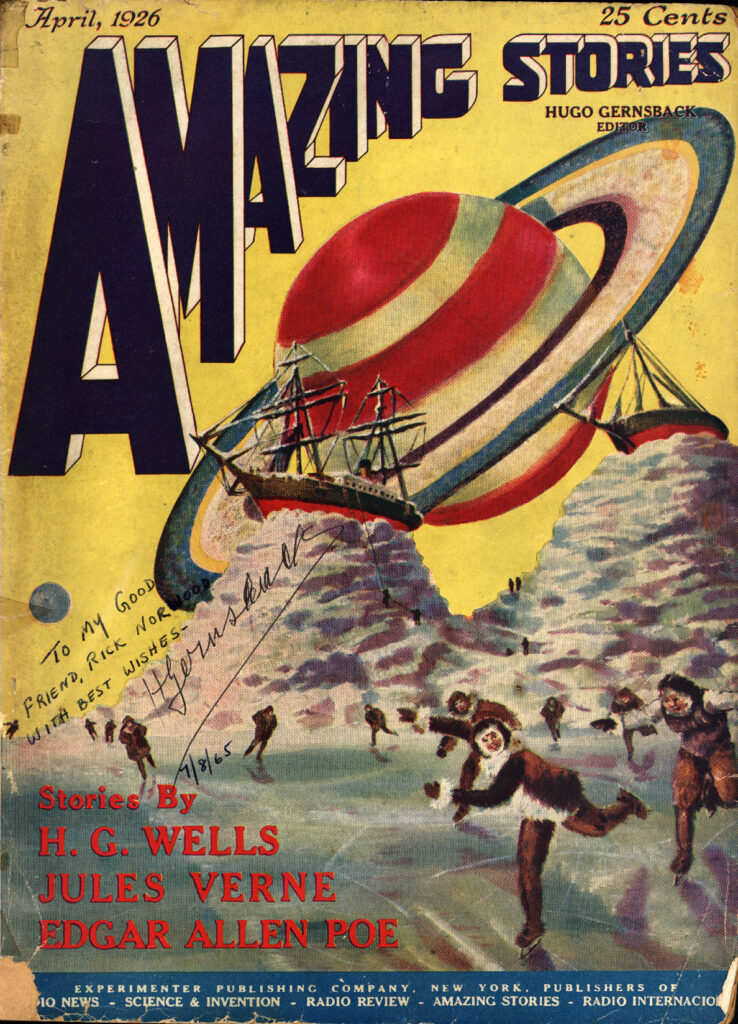
If you’ve ever lost yourself in a tale of interplanetary travel, rogue artificial intelligence, or bizarre alien ecology, you owe a massive debt of gratitude to a single pulp magazine launched in April 1926: Amazing Stories.
Long before paperbacks dominated bookstore shelves or massive cinematic universes ruled the box office, Amazing Stories created the modern blueprint for science fiction. It didn’t just publish stories—it launched a literary revolution.
The Mastermind: Hugo Gernsback
Before 1926, speculative fiction existed, but it was scattered. Writers like H.G. Wells, Jules Verne, and Edgar Allan Poe wrote what was loosely termed “scientific romance” or “offbeat fiction.”
Enter Hugo Gernsback, an eccentric inventor, publisher, and visionary.
Gernsback realized that readers were hungry for stories rooted in actual scientific possibility. He coined the term “scientifiction” (which eventually evolved into “science fiction”) and launched Amazing Stories with a bold editorial mission:
“By ‘scientifiction’ I mean the Jules Verne, H. G. Wells, and Edgar Allan Poe type of story—a charming romance intermingled with scientific fact and prophetic vision.”
Iconic Covers & Visual Brilliance
You couldn’t walk past a newsstand in the late 1920s without your eyes being glued to an issue of Amazing Stories.
Much of that visual magic was thanks to artist Frank R. Paul. His vivid, vibrant, and wildly imaginative cover illustrations featured:
- Giant robotic behemoths wading through futurist cities
- Massive, iridescent space insects and alien leviathans
- Heroic explorers battling bizarre cosmic forces on distant worlds
These covers weren’t just decoration; they were window displays into entirely new dimensions of imagination that defined the pulp aesthetic forever.
Launchpad for Legends
While Amazing Stories started by reprinting classics from Verne and Wells, it quickly became the premier launchpad for new talent. It gave voice to groundbreaking authors who would shape the genre for decades, including:
- E.E. “Doc” Smith (pioneer of the grand space opera)
- Jack Williamson
- John W. Campbell
- H.P. Lovecraft (whose seminal work “The Colour Out of Space” debuted in the September 1927 issue)
Beyond the stories, Gernsback included a “Discussions” letter column, allowing readers from across the country to connect, debate scientific theories, and share their love for the genre. This letter section effectively birthed modern sci-fi fandom.
The Lasting Legacy
Amazing Stories proved that the human imagination has no ceiling. It took speculative concepts out of niche academic circles and brought them directly into the hands of everyday dreamers, artists, and future scientists.
Today, every piece of vintage pulp art—from high-contrast retro mugs to classic canvas totes—carries a piece of that 1920s sense of wonder.